
Home Care Fall Prevention: What Works

Home care teams see clients at home more than anyone else. The evidence points to clear steps that reduce falls, and home care teams are well placed to put them in motion.
Home care providers are on the front lines of helping older adults live, and thrive, safely at home. Home care teams often see clients at home more than anyone else, which often makes them the first to notice when someone is becoming unsteady and, with Able Assess, the first to check objectively whether they may be at risk of falling. They are also the ones who coordinate what happens next: connecting clients with physical therapists, exercise programs, home modification services and their doctor, and keeping that plan on track between visits. Home care fall prevention doesn't have to be guesswork. The evidence points to clear steps that reduce falls, and home care teams are well placed to put them in motion.
Want the full picture? This article draws on our evidence report, Fall Prevention for Older Adults at Home: A Report on the Evidence Base.
Where older adults fall at home
Most falls happen during ordinary daily routines, and a few moments carry most of the risk.
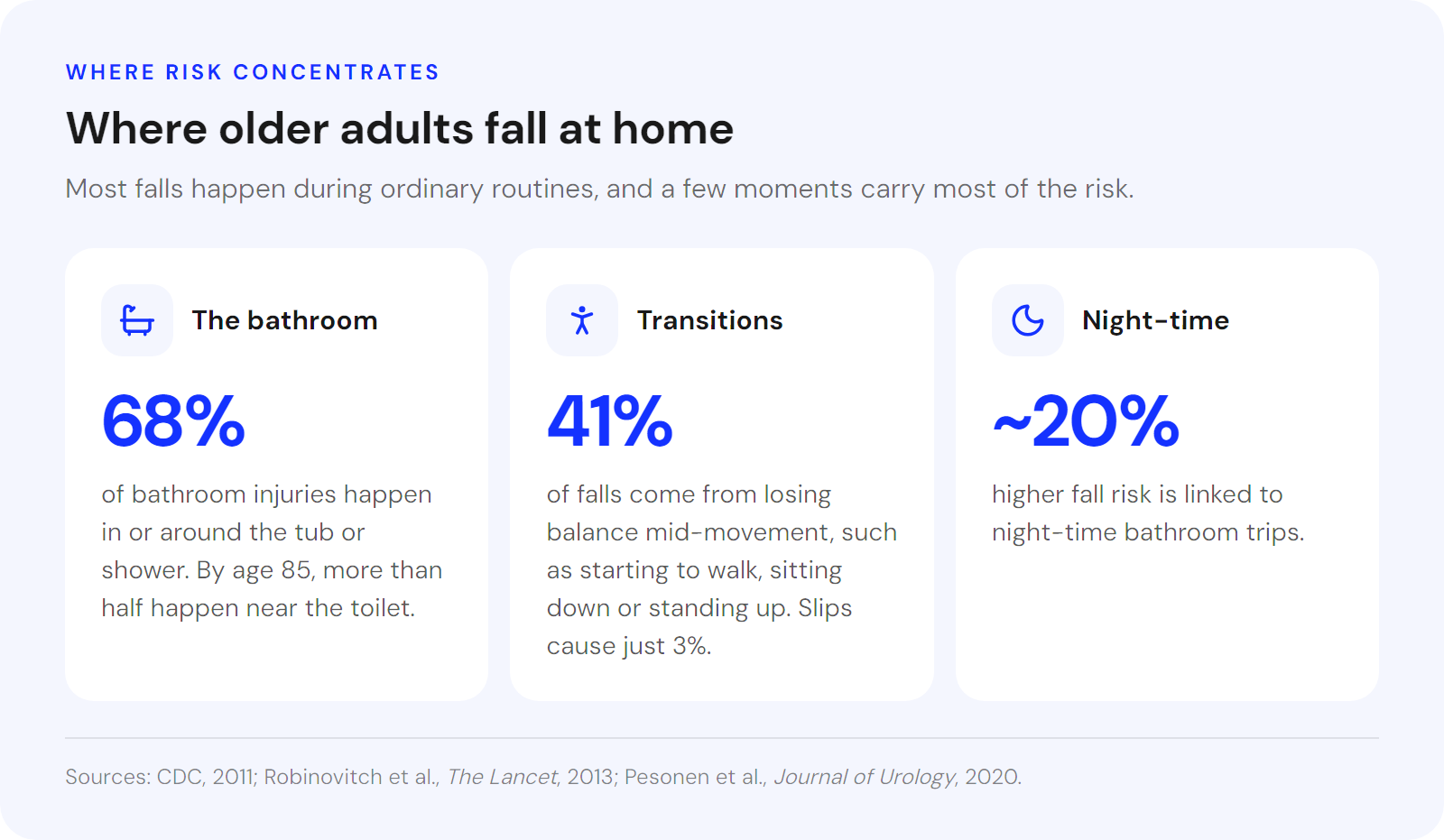
- The bathroom is ground zero. 68% of bathroom injuries happen in or around the tub or shower. By age 85, more than half happen near the toilet.¹
- Transitions are the danger zone. Only 3% of falls come from slipping. The leading cause (41%) is losing balance mid-movement: starting to walk, sitting down or standing up.²
- Nighttime raises the stakes. Night-time bathroom trips are linked to ~20% higher fall risk.³
Evidence-based fall prevention strategies for home care
Each approach below is backed by research, and each comes with practical steps home care teams can take to support it.

Home care support
What the research shows: Home care can make falls less harmful: among older adults with significant disability, those receiving paid care had 58% lower risk of fall-related injury.⁴
How home care can help:
- Encourage clients to use care support during high-risk moments
- Prioritize transitions: getting on and off the toilet, in and out of the shower, and out of bed at night

Exercise
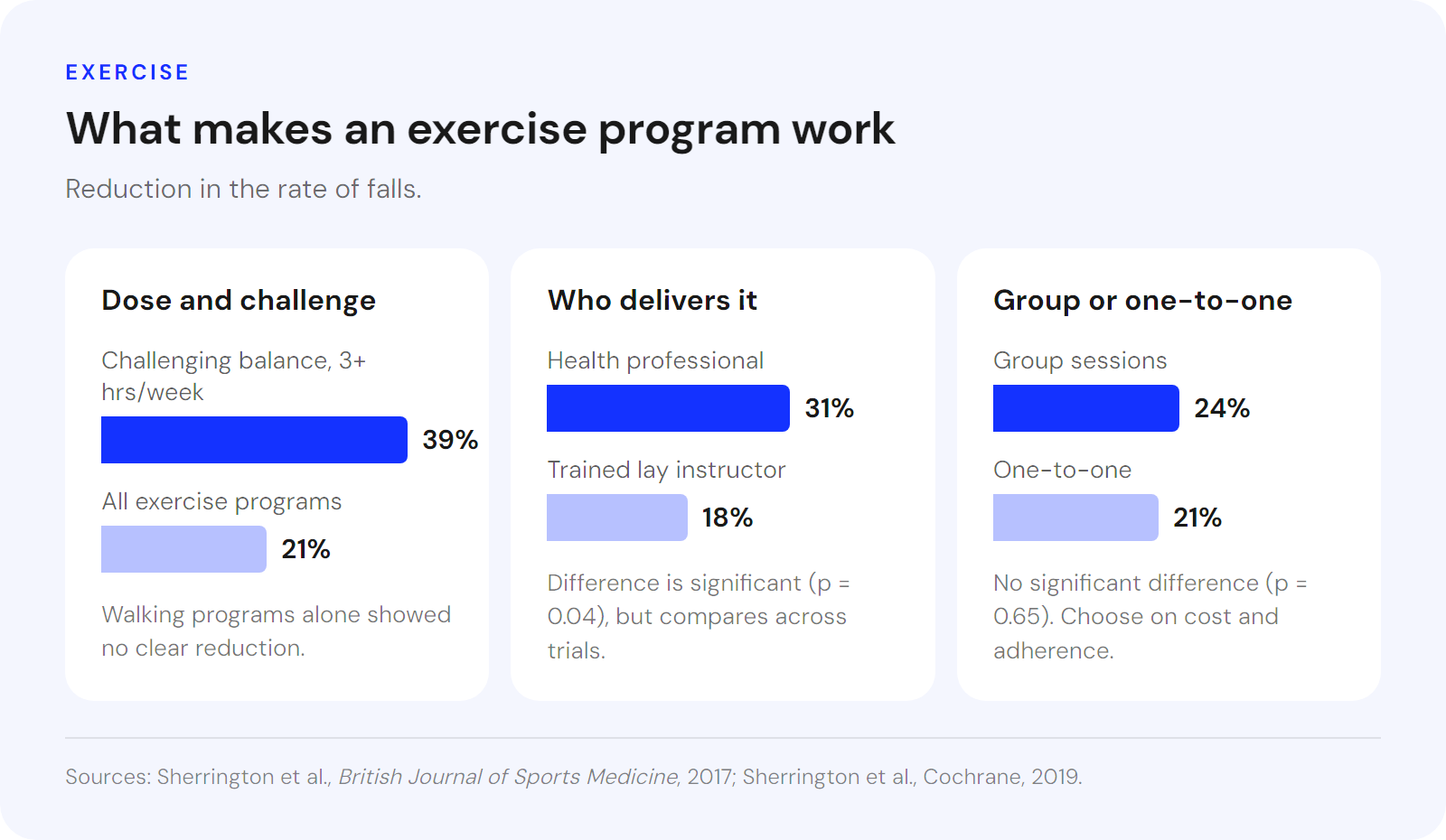
What the research shows: Balance and strength exercise cuts falls by 23%, and by 39% when it challenges balance and runs more than three hours a week.⁵˒⁶ It is the only fall-prevention intervention the USPSTF grades B,⁷ and programs led by physical therapists show the strongest results: 31% fewer falls, versus 18% with non-professional instructors.⁵
How home care can help:
- Help clients find supported, evidence-based programs like Otago⁸ and Tai Ji Quan (Tai Chi).⁹ Look to local Area Agencies on Aging (AAAs) and senior centers, which often offer these programs
- Build referral partnerships with home health agencies and other physical therapy providers. Encourage clients to share their Able Assess screening report with their physical therapist

Home hazard reduction
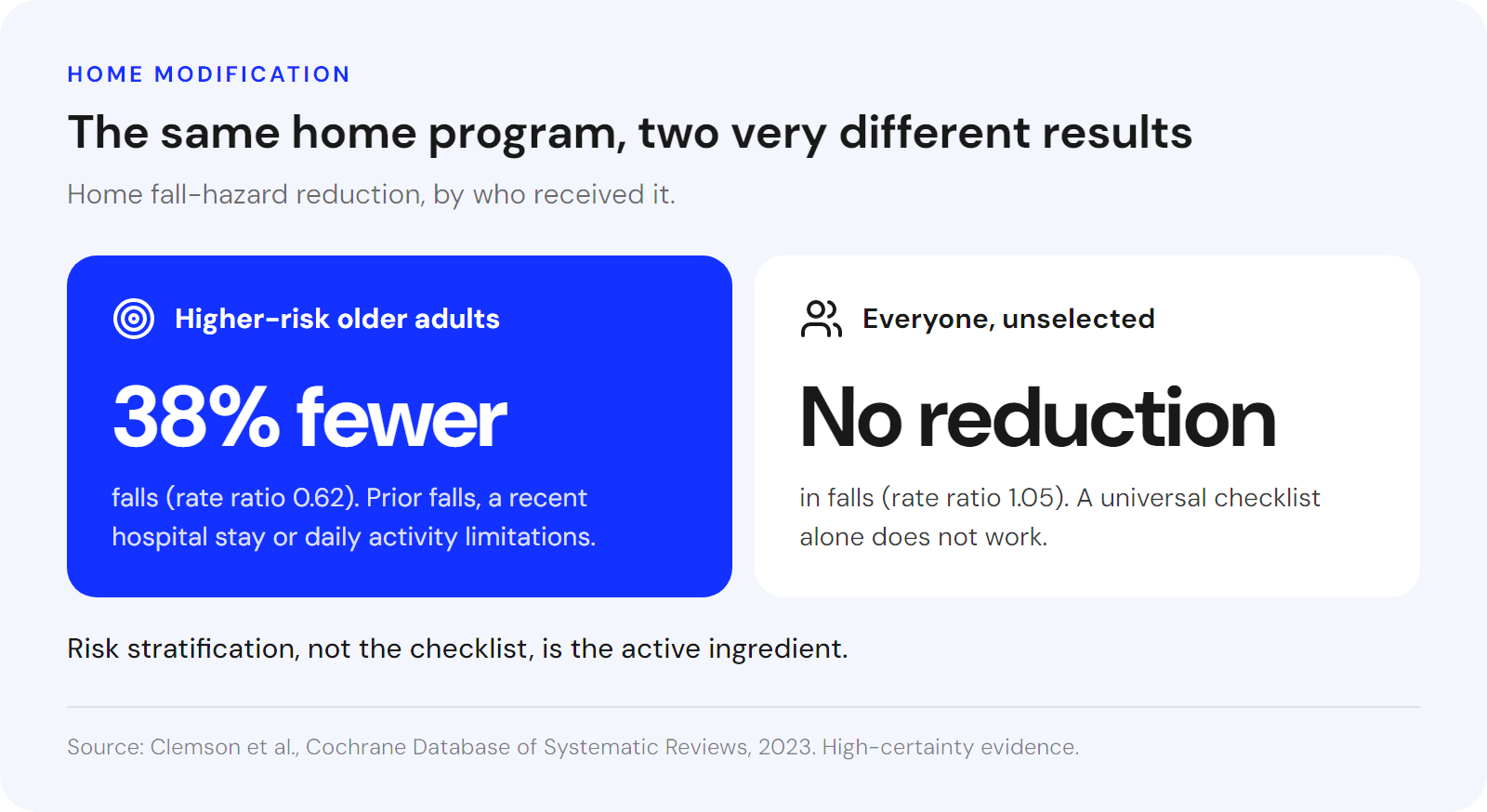
What the research shows: Targeted home modifications cut falls by 38% in older adults at higher risk, but showed no clear benefit when offered to everyone.¹⁰ Footwear matters too: athletic and canvas shoes carry the lowest fall risk, while bare feet or socks carry the highest.¹¹
How home care can help:
- Partner with home modification companies to install grab bars, rails and night lighting
- Review clients' homes for trip hazards like loose rugs and clutter
- Encourage sturdy, supportive footwear

Doctor's visit
What the research shows: Medication review and treating conditions like cataracts or foot pain can lower fall risk,¹²˒¹³ and drops in blood pressure on standing are linked to more falls.¹⁴
How home care can help:
- Encourage clients to bring their Able Assess screening report to their doctor and ask for a medication review, blood pressure check, and review of any other health conditions that raise fall risk.
Fall risk screening is part of the intervention
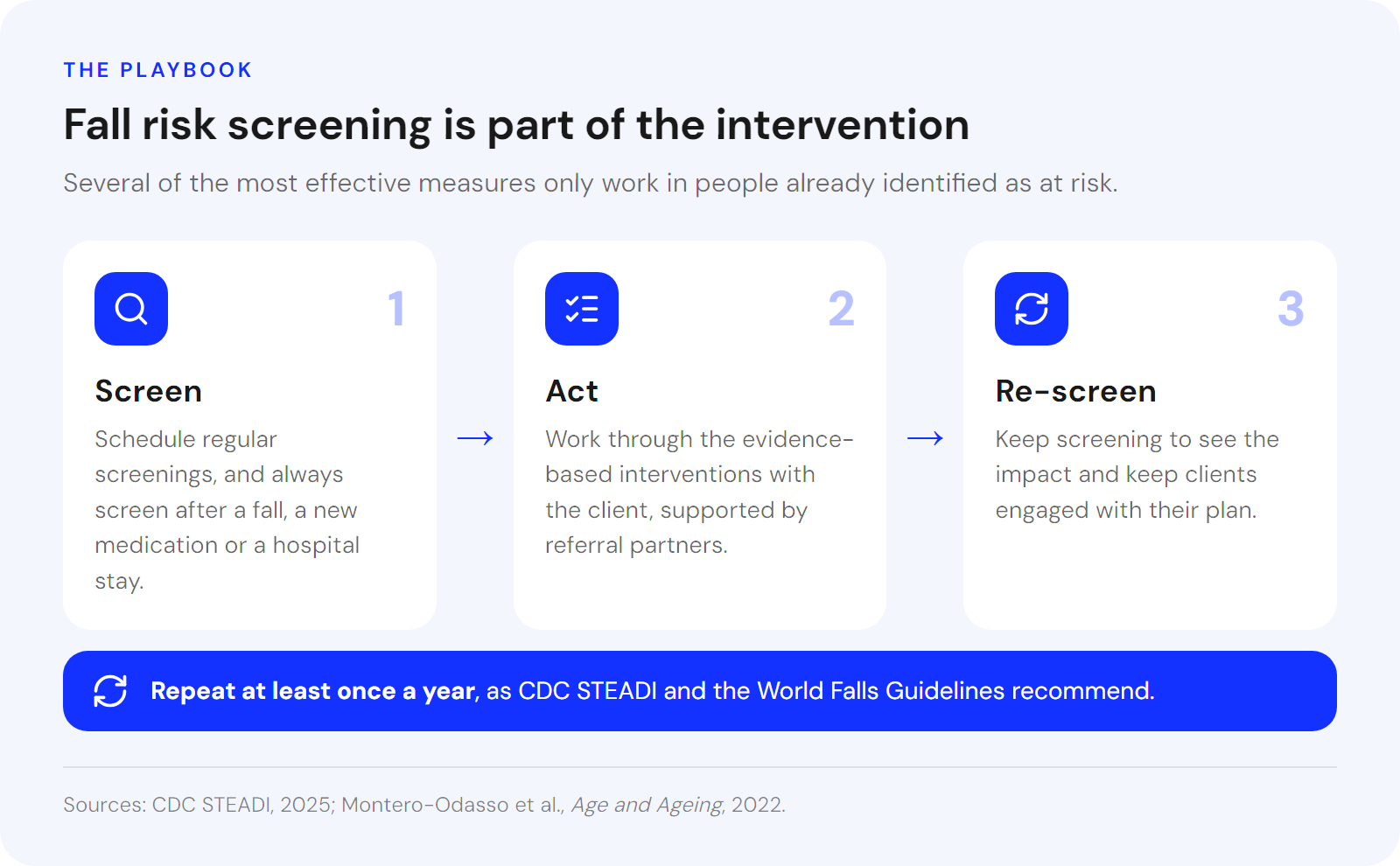
Several of the most effective measures only work in people already identified as at risk. That makes screening the step that unlocks everything else, not a box to tick first. The playbook:
- Screen: schedule regular screenings, and always screen after a fall, a new medication or a hospital stay.
- Act: when clients are at a fall risk, run down the list of evidence-based interventions they can pursue, and build relationships with referral partners who can support them.
- Re-screen: continue screening to assess the impact and encourage ongoing engagement with interventions.
Where Able Assess fits into a home care fall prevention program
Able Assess delivers a fast, objective measure of the functional factors behind an individual's fall risk, and it's built so home care staff at any training level can run it, from caregivers to nurses. That puts fall risk screening in the hands of the people who see clients most, so the right people get pointed toward proven support, sooner. Assessment alone doesn't prevent falls; it makes prevention possible.
Frequently asked questions about home care fall prevention
How can home care agencies help prevent falls?
Home care teams see clients more often than any other provider. That puts them in a good position to screen for fall risk, offer support during high-risk moments like bathing and toileting, and connect clients with proven programs such as physical therapy, exercise classes and home modifications.
What are the most effective fall prevention strategies for older adults?
Balance and strength exercise has the strongest evidence, cutting falls by 23–39%.⁵˒⁶ Targeted home hazard reduction cuts falls by 38% in people at higher risk.¹⁰ Medication review and treating specific conditions, like cataracts, also help.¹²˒¹³
What is the Otago Exercise Program?
Otago is a strength and balance program prescribed by a physical therapist, with 17 exercises plus walking. In one trial of older adults who had already had a fall, it led to 36% fewer falls.⁸
Where do most falls happen at home?
Most falls happen during everyday transitions, like sitting down, standing up and starting to walk. The bathroom is a hotspot, especially at night.¹⁻³
How often should clients be screened for fall risk?
CDC and international guidelines recommend checking fall risk at least once a year. Clients should also be rescreened after any fall, any new medication or any hospital stay.¹⁵˒¹⁶
Can caregivers without clinical training screen for fall risk?
Yes. Able Assess is designed so home care staff at any training level can screen for fall risk quickly, using objective measures.
Based on Able Care's full evidence review, Fall Prevention for Older Adults at Home: A Report on the Evidence Base, with sources including Cochrane, USPSTF, CDC STEADI and the 2022 World Falls Guidelines.
References
- Stevens JA, Haas EN, Haileyesus T. Nonfatal bathroom injuries among persons aged ≥15 years—United States, 2008. MMWR Morb Mortal Wkly Rep. 2011;60(22):729-733. cdc.gov
- Robinovitch SN, Feldman F, Yang Y, et al. Video capture of the circumstances of falls in elderly people residing in long-term care: an observational study. Lancet. 2013;381(9860):47-54. doi:10.1016/S0140-6736(12)61263-X
- Pesonen JS, Vernooij RWM, Cartwright R, et al. The impact of nocturia on falls and fractures: a systematic review and meta-analysis. J Urol. 2020;203(4):674-683. doi:10.1097/JU.0000000000000459
- Hoffman GJ, Hays RD, Wallace SP, Shapiro MF, Yakusheva O, Ettner SL. Receipt of caregiving and fall risk in US community-dwelling older adults. Med Care. 2017;55(4):371-378. doi:10.1097/MLR.0000000000000677
- Sherrington C, Fairhall NJ, Wallbank GK, et al. Exercise for preventing falls in older people living in the community. Cochrane Database Syst Rev. 2019;1(1):CD012424. doi:10.1002/14651858.CD012424.pub2
- Sherrington C, Michaleff ZA, Fairhall N, et al. Exercise to prevent falls in older adults: an updated systematic review and meta-analysis. Br J Sports Med. 2017;51(24):1750-1758. doi:10.1136/bjsports-2016-096547
- US Preventive Services Task Force. Falls prevention in community-dwelling older adults: interventions. Published June 4, 2024. Accessed November 17, 2026. uspreventiveservicestaskforce.org
- Liu-Ambrose T, Davis JC, Best JR, et al. Effect of a home-based exercise program on subsequent falls among community-dwelling high-risk older adults after a fall: a randomized clinical trial. JAMA. 2019;321(21):2092-2100. doi:10.1001/jama.2019.5795
- Li F, Harmer P, Fitzgerald K, et al. Effectiveness of a therapeutic Tai Ji Quan intervention vs a multimodal exercise intervention to prevent falls among older adults at high risk of falling: a randomized clinical trial. JAMA Intern Med. 2018;178(10):1301-1310. doi:10.1001/jamainternmed.2018.3915
- Clemson L, Stark S, Pighills AC, et al. Environmental interventions for preventing falls in older people living in the community. Cochrane Database Syst Rev. 2023;3(3):CD013258. doi:10.1002/14651858.CD013258.pub2
- Koepsell TD, Wolf ME, Buchner DM, et al. Footwear style and risk of falls in older adults. J Am Geriatr Soc. 2004;52(9):1495-1501. doi:10.1111/j.1532-5415.2004.52412.x
- Campbell AJ, Robertson MC, Gardner MM, Norton RN, Buchner DM. Psychotropic medication withdrawal and a home-based exercise program to prevent falls: a randomized, controlled trial. J Am Geriatr Soc. 1999;47(7):850-853. doi:10.1111/j.1532-5415.1999.tb03843.x
- Gillespie LD, Robertson MC, Gillespie WJ, et al. Interventions for preventing falls in older people living in the community. Cochrane Database Syst Rev. 2012;(9):CD007146. doi:10.1002/14651858.CD007146.pub3
- Mol A, Bui Hoang PTS, Sharmin S, et al. Orthostatic hypotension and falls in older adults: a systematic review and meta-analysis. J Am Med Dir Assoc. 2019;20(5):589-597.e5. doi:10.1016/j.jamda.2018.11.003
- Centers for Disease Control and Prevention. STEADI—Older adult fall prevention. Updated 2025. Accessed November 17, 2026. cdc.gov/steadi
- Montero-Odasso M, van der Velde N, Martin FC, et al. World guidelines for falls prevention and management for older adults: a global initiative. Age Ageing. 2022;51(9):afac205. doi:10.1093/ageing/afac205